
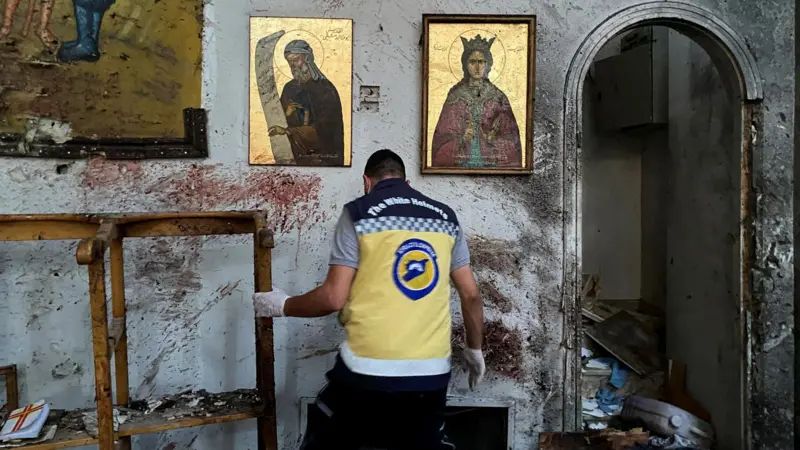

At least 25 people were killed and 63 injured on Sunday evening following a suicide bombing at the Greek Orthodox Church of the Prophet Elias in the Dweila neighborhood of Damascus, according to Syria’s health ministry.
The attack occurred during an evening service. A lone assailant opened fire inside the church before detonating an explosive vest.
Syrian interior ministry officials confirmed the attacker was affiliated with Islamic State (IS), though the group has not yet claimed responsibility.
Graphic photos and videos showed shattered pews, bloodstained walls, and a damaged altar, underscoring the blast’s intensity.
Eyewitness Lawrence Maamari told AFP: “Someone entered with a weapon and started shooting. People tried to stop him before he blew himself up.”
Another witness, Ziad, described hearing gunfire and a loud explosion that sent glass flying into the streets.
This is the first major terror attack in Damascus since Bashar al-Assad was overthrown in late 2024, bringing an end to 13 years of civil war.
The Greek Orthodox Patriarchate of Antioch issued a scathing statement condemning the attack as a “treacherous strike on our martyrs” and demanded action from Syria’s interim government to protect religious minorities.
Greek Prime Minister Kyriakos Mitsotakis also urged the Syrian authorities to guarantee the safety of all ethnic and religious groups.
Meanwhile, the United Nations and United States issued strong condemnations. UN envoy Geir Pedersen called for “unity against terrorism,” while U.S. special envoy Tom Barrack said the act had “no place in a Syria striving for peace and inclusion.”
Syria’s interim President Ahmed al-Sharaa, who leads the controversial Islamist group Hayat Tahrir al-Sham (HTS), reiterated promises to protect minorities, though critics say sectarian violence is on the rise.
The group is designated as a terrorist organization by the UN, US, and UK.
Despite its territorial defeat in 2019, Islamic State remains active, with an estimated 1,500–3,000 fighters operating in Syria and Iraq.
A February UN report warned that IS could exploit Syria’s fragile transition to regroup and escalate attacks.
The bombing has raised fresh fears that Syria could again become a hotspot for extremist recruitment and sectarian violence, especially with over 9,000 IS fighters still held in detention across the region.
Arab League Secretary-General Ahmed Aboul Gheit expressed hope that Syria’s authorities can stabilize the situation and dismantle remaining terror networks.