
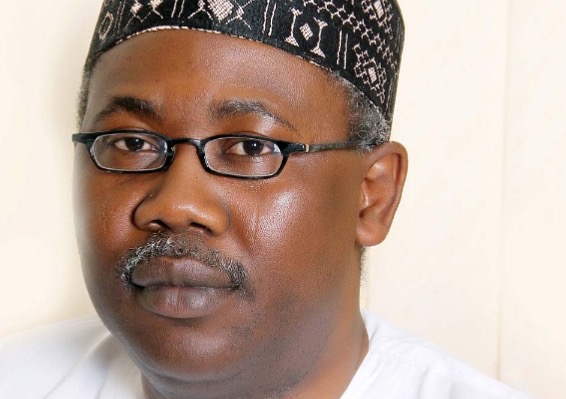

Former Attorney General of Federation , AGF, and Minister of Justice Mohammed Bello Adoke, SAN, has urged Nigerians to safeguard the country democracy from further eroding and collapsing as it stands at precarious crossroads.
He said the appeal became necessary and urgent because “a closer examination of our polity will reveal that Nigeria stands at democracy’s precarious crossroads.”
Adoke ,SAN , stated this in a lecture titled “Safeguarding Nigeria’s Democratic Process: issues and Prospects” he delivered at the 2026 Annual Law Week of the Nigerian Bar Association, Abuja Branch (the Unity Bar).
He said that it’s been 27 years since the 1999 Constitution heralded civilian rule and vested sovereignty in the people, “yet trust in the electoral process continues to erode perilously.”
“The 2023 general elections claimed 89 lives amid violence, recorded a dismal 27% voter turnout, the lowest since 1999 and left INEC, the electoral management body’s credibility shattered, as reported in the 2023 EU Election Observation Mission’s Final Report.”
While, vote-buying infected 40% of voters according to Yiaga Africa’s Nigeria Election Parallel Vote Tabulation and Incident Report 2023, the Presidential Election Petition Tribunals delayed 12 months beyond the 180-day constitutional limit under section 285(6) of the Constitution of the Federal Republic of Nigeria, 1999, according to INEC, 2023 General Elections Tribunal Report (2024), constituting grave constitutional infractions.”
He said that democracy in Nigeria has endured since 1999 and that, in itself, is no small achievement. “But let us be honest: endurance is not the same as excellence, and continuity is not the same as credibility.”
According to him, a democracy is not measured merely by how often it holds elections, but by how deeply its people trust the outcomes of those elections.”
Thus, the real question before us is not whether Nigeria is democratic. It is far more searching: “Are we safeguarding the democratic process, or merely managing its appearance?
Because when the process loses credibility, democracy does not collapse overnight; it erodes. Slowly. Quietly. Almost imperceptibly. Until one day, participation becomes routine, but belief has already left the room,” he warned.
Adoke SAN said that unfortunate occurrences witnessed in the polity, has understandably occasioned anxiety amongst the populace, forcing Nigerians to question whether indeed the 2027 elections will renew our democratic experiment or destroy it irreparably.
He pointed out, that Nigerians do not yearn for democracy for its own sake, nor do they want to be passive onlookers in the democratic process. They want a democratic process that guarantees their participation — one where elections are free, fair and credible.
Safeguarding the democratic process, therefore, demands more than procedure. It demands integrity in the process, discipline among political actors, courage from institutions, and vigilance from citizens. It requires that the law is not only written, but obeyed; that institutions are not only established, but trusted; and that elections are not only conducted, but believed.
He said that we should as a matter of urgency interrogates the structural challenges confronting Nigeria’s democratic process, the prospects for restoring credibility, and advances concrete recommendations anchored in constitutional principles, electoral law, and institutional responsibility.
Adoke said that the
Constitutional and Legal Foundations in place must be followed strictly and obeyed adding that at the heart of Nigeria’s Democratic architecture lies a simple yet profound idea that power belongs to the people, therefore the country should safeguard Sovereignty of the people and people’s participation in electoral processes.
He wonders that on paper, the Nigerian Constitution provides a robust framework for participation. But in practice, several distortions occur.
Such that Party primaries now undermines the constitutional promise of equal opportunity
Financial barriers restrict access to political competition.
Electoral malpractices dilute the value of participation and these creates participation paradox.
He asked, “are Nigerians truly participating in their government, or merely observing it?
He said that until participation becomes meaningful, inclusive, and credible, the promise of sovereignty will remain only partially fulfilled.
“I submit with respect that a democracy where sovereignty is only partially realised is a democracy still in search of itself.”
Adoke SAN also spoke extensively on electoral violence , betrayed legal framework, monetisation of Politics,Internal Party Democracy, Electoral maladministration.