
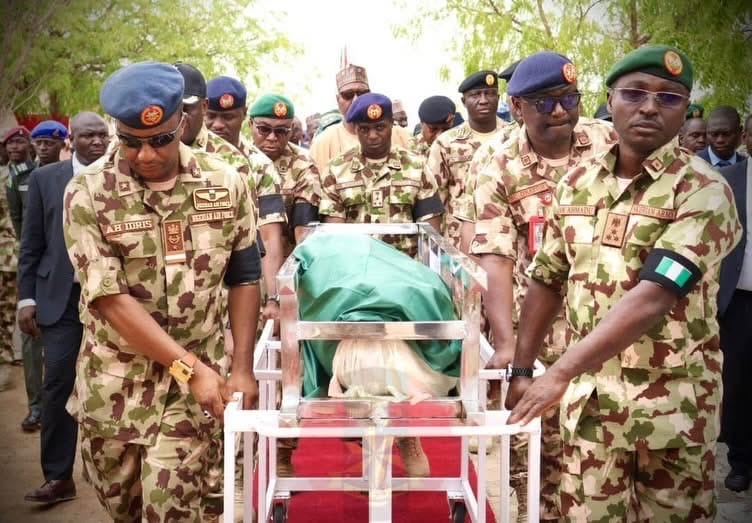

The remains of late Brigadier General Omo Braimo, Captain Ismail, and other gallant soldiers who paid the supreme prices on 9 April were laid to rest in Maiduguri on Wednesday 15 April 2026 with full military honours.
In a solemn ceremony steeped in grief, pride, and reverence, Nigeria bid a final farewell to some of its bravest sons—men who gave their lives in defence of the nation’s unity and peace.
They were buried in at the Maimalari Cantonment Cemetery in Maiduguri, Borno State, in an atmosphere heavy with emotion as Late Brigadier General Omo Braimo, Captain Ismail, and other gallant soldiers were laid to rest with full military honours.
Beneath a quiet sky, amid the echo of ceremonial gun salutes and the mournful notes of military bugles, the nation paused to honour sacrifice in its purest form.
Rows of uniformed personnel stood in disciplined silence, their faces reflecting both loss and pride. Families of the fallen—draped in grief yet dignified in bearing—watched as the remains of their loved ones were committed to the earth. For them, this was not just a national moment, but a deeply personal loss that words can scarcely capture.
The ceremony drew an array of dignitaries, underscoring the weight of the occasion. Among them was the Governor of Borno State, Professor Babagana Umara Zulum, alongside the Honourable Minister of Defence, General Christopher Musa (Rtd), the Chief of Defence Staff, General Olufemi Oluyede, the Chief of Army Staff, Lieutenant General Waidi Shaibu and other senior military and security agencies officials.
Their presence signified a collective acknowledgement of the price paid by those on the frontlines of Nigeria’s security challenges.
In heartfelt tributes, COAS, CDS, Minister of Defence, and Governor of Borno State described the fallen soldiers as patriots who embodied courage, discipline, and an unwavering commitment to duty.
They spoke of men who stood firm in the face of danger, choosing service above self, and ultimately paying the supreme price so that millions of Nigerians could live in safety.
Governor Zulum, visibly moved, praised the bravery of the deceased and reaffirmed the state’s continued support for the Armed Forces and the families left behind. The Minister of Defence and top military commanders echoed the deceased soldiers’ similar unflinching commitment to duty, noting that the legacy of the fallen would endure as a source of inspiration for both serving personnel and future generations.
As citations detailing the lives and service records of the deceased were read aloud, the magnitude of their sacrifice became even more evident. Each story told of dedication, resilience, and an unbreakable oath to defend the nation at all costs.
At the burial prayers were offered for the peaceful repose of their souls, while flags were carefully folded and presented to next of kin—a symbolic gesture of a grateful nation. Yet, beyond the ceremony and tradition, the raw grief of families served as a poignant reminder of the human cost of conflict.
For Nigeria, the loss is both collective and profound. These men were not just soldiers; they were fathers, brothers, sons, and friends—individuals whose absence will be deeply felt far beyond the battlefield.
As the final notes of the bugle faded and the crowd slowly dispersed, one truth remained clear: the freedom and stability enjoyed by the nation are built on the sacrifices of men and women who risk—and sometimes give—their all.
In honouring them, Nigeria not only mourns but also renews its commitment to the ideals they died defending. Their memory, etched in the nation’s history, will continue to serve as a beacon of courage, sacrifice, and unwavering patriotism.