
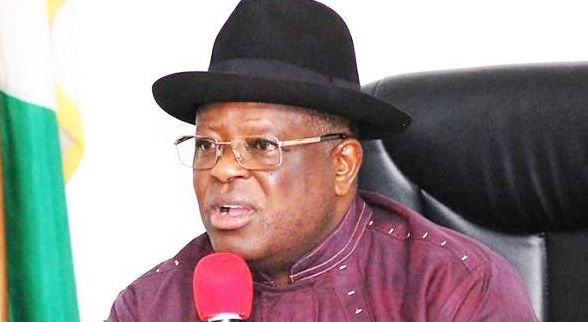

Abuja witnessed a charged atmosphere on Sunday, 1st March, 2026, as four prominent women led organisations jointly addressed the press in firm defence of the Minister of Works, David Nweze Umahi, over the viral allegations made by Mrs Tracy Nicholas Ohiri.
The groups, Women Advocates for Responsible Governance, WARG, Women for Justice and Institutional Integrity, WJII, Coalition of Patriotic Nigerian Women, CPNW, and National Women Alliance for Rule of Law, NWARL, declared that the accusations circulating online lack documentary foundation and should be subjected to proper judicial scrutiny rather than social media agitation.
Speaking first, Dr. Amina Yusuf, National President of WARG, said the organisation was “outraged not because a woman spoke, but because reckless allegations are being weaponized to attack governance without proof.”
She argued that the claim of a ₦24.5 million transaction allegedly dating back to 2015 collapses under basic commercial scrutiny. According to her, no serious campaign structure handles transactions of that magnitude without written contracts, invoices, acknowledgements of delivery, or documented financial processes.
“Nearly ten years later, there is no contract, no invoice trail, no formal demand letter, no court filing. Instead, we are presented with emotional videos. Governance is not theatre,” she stated, questioning why the matter was not legally pursued in 2016, 2017, or 2018 if it were genuine.
Hajia Halimat Bello, Executive Director of WJII, framed her organisation’s support around institutional principle rather than sentiment. She emphasized that justice requires proof and that institutional integrity demands discipline.
“The minimum threshold of commercial credibility has not been met. A transaction of ₦24.5 million cannot exist without documentation. If such supply truly occurred, where is the acknowledgment, where is the procurement structure, where is the civil recovery suit?” she asked.
She further warned against the emotional framing of allegations, noting that sensitive claims should not be used to provoke public sympathy without evidence, as doing so risks undermining trust in legitimate grievances nationwide.
For the Coalition of Patriotic Nigerian Women, Mrs Folake Adeyemi stressed that the narrative fails basic logic. She described the idea of a multi million naira supply without written agreement, advance payment, arbitration, legal notice, or litigation for nearly a decade as implausible.
“As patriotic women committed to national stability, we cannot stand idle while a serving minister supervising strategic infrastructure corridors is distracted by allegations that do not withstand scrutiny,” she said. She added that if it were truly a debt recovery matter, the courts would have been approached years ago.
Dr Grace Onuoha, speaking on behalf of NWARL, shifted the focus to the broader implications for democracy. She warned that the rule of law is endangered when social media becomes judge and jury.
“Public officials are accountable, but accountability must follow lawful procedure. File a claim. Submit documentation. Present evidence. Allow judicial determination. Nigeria cannot operate on viral verdicts,” she said.
The four organisations maintained that their intervention was rooted in principle, not personality, insisting that the presumption of innocence and adherence to due process must remain central in public discourse.
They collectively called on Nigerians to resist trial by ambush, to reject reputational warfare disguised as activism, and to allow competent legal institutions to determine the validity of the claims.
As the controversy continues to generate debate online, the women groups made one position unmistakably clear, allegations must be proven in court, not performed for cameras.