
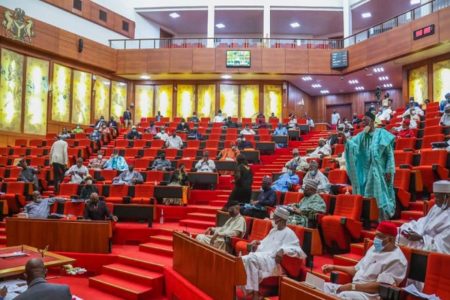

In a bid to strengthen Nigeria’s financial institutions the Senate on Wednesday took further legislative steps towards hike in the capital base of the Nigerian Export-Import Bank, NEXIM to N1 trillion, the establishment of an Export Development Trust Fund, and the creation of a special tribunal to resolve insurance disputes.
Specifically, the Red Chamber, through its Committee on Banking, Insurance and Other Financial Institutions, organised a public hearing on two critical bills – the Nigerian Export-Import Bank (Amendment) Bill, 2025 and the National Insurance Commission (Repeal) and Insurance Regulatory Commission Bill, 2025 to achieve the proposed reforms.
Chairman of the committee, Senator Adetokunbo Abiru (APC Lagos West), said at the event that the two pieces of legislation were designed to fortify Nigeria’s financial ecosystem and align it with global standards.
Abiru said the bills represented “a crucial step in shaping the future of Nigeria’s financial system” by modernizing outdated laws and fostering innovation-driven regulation.
According to him, the NEXIM Amendment Bill would update the 1991 Act that established the bank, while the new Insurance Regulatory Commission Bill seeks to replace the obsolete 1997 NAICOM Act.
Both, he said, would “ensure Nigeria’s financial system becomes more transparent, competitive, and globally aligned.”
“Effective lawmaking is never a solitary process. We are here to critically examine both bills and ensure they align with our national goals of economic transformation and financial stability,” he stressed.
Declaring open the event, the Senate President Godswill Akpabio, described the two bills as “a covenant with Nigeria’s economic future.”
Akpabio, who was represented by the Senate Chief Whip, Senator Tahir Monguno (APC Borno North), said the proposed reforms were not mere legislative exercises but instruments of national renewal.
He said, “The NEXIM Bank is not just a bank; it is a bridge between our factories and the world. It must be empowered to lead, not just to lend.
“Similarly, the insurance sector must rise beyond routine paperwork to become a bulwark of trust and fairness in our economy.”
Akpabio urged lawmakers to legislate “for posterity, not convenience,” emphasizing that history would remember the 10th Senate as one that “met the hour with clarity, courage, and conviction.”
In his remarks, the NEXIM Bank Managing Director, Abba Bello, justified the proposed amendments, stressing that the 33-year-old law had become obsolete.
According to him, the bank’s current capital of N50 billion, roughly $33 million, was “grossly inadequate” to support Nigeria’s expanding export ambitions, particularly under the African Continental Free Trade Area, AfCFTA.
“We fully support the proposal to raise the capital base to at least ₦500 billion, and ideally N1 trillion, to enable NEXIM to deliver on its mandate,” he said.
Bello also backed reforms that would separate the roles of the Central Bank of Nigeria, CBN from NEXIM’s board leadership, promote continuity of governance, and create an Export Development Fund to support export-oriented businesses.
Supporting Bello’s position, the Capital Market Academics of Nigeria urged lawmakers to peg NEXIM’s minimum capital at N1 trillion instead of N500 billion, citing the stronger financial standing of peer institutions in India, China, and South Africa.
The association in its position paper said, “NEXIM’s undercapitalization has limited its impact and excluded it from global credit ratings,” calling for a more inclusive board structure featuring the Chartered Institute of Bankers and the National Association of Chambers of Commerce.
The Ministry of Finance Incorporated, MOFI also supported the N1 trillion benchmark and clarified that the government’s shares in NEXIM should be held through MOFI, in line with its statutory mandate as the Federal Government’s asset-holding entity.
Similarly, the Commissioner for Insurance, Mr. Olusegun Ayo Omosehin, described the establishment of an Export Promotion Trust Fund as “a masterstroke” that could transform Nigeria’s non-oil export sector.
“This is a long-overdue innovation that will allow exporters to access funding for raw materials, logistics, and capital goods,” Omosehin said.
The Nigeria Deposit Insurance Corporation, NDIC in it’s position paper, called for its inclusion on the NEXIM board, citing its expertise in risk management.
It also supported the higher capital base and demanded stricter accountability for the proposed trust fund.