

We Ijẹ̀bus are Yorùba people.
The first Portuguese adventurers who wrote of their trading forays into West Africa described what is now called Nigeria as “Ijebu country”.
They thought the entire area now called Nigeria was Ijẹ̀bu.
“Ijebu country”, because, of course, that was before they made inland forays.
For example, Duarte Pacheco Pereira, a Portuguese adventurer and diarist who started visiting the coast of West Africa from 1485, described external trade in Ijẹ̀buland like this : “… the trade which can be con¬ducted here (Ijẹ̀bu country) is the trade in slaves, who are sold !”
Professor Toyin Falọlá concluded in his Yoruba Warlords of the Nineteenth Century, Chapter 7, page 125 that,
“The Ijẹ̀bu lived in a territory bounded in the north by the Oyo, on the north-east by the Ife, on the west by the Egba and on the east by the Ondo people. In the south-west, their land stretched as far as the Lagos lagoon . . .. They were largely a trading people. Before the nineteenth century, their geographical position near the coast enabled them to have access to the European merchants from whom they bought articles which they exchanged with the goods procured from other Yoruba people in the hinterland. Indeed, records of European trading contacts with the Ijebu date back to the sixteenth century.”
Other records of European encounters with the Ijẹ̀bu are preserved in the wood-panelled main library at the University of Coimbra, Portugal. The University of Coimbra was established in 1291.
The Yorùba state called Lagos State is 79% Ijẹbù land.
Lagos State is therefore 99.99% Yorùbaland, if you believe Rilwan Akiolu’s fanciful claims that Lagos Island is Bini.
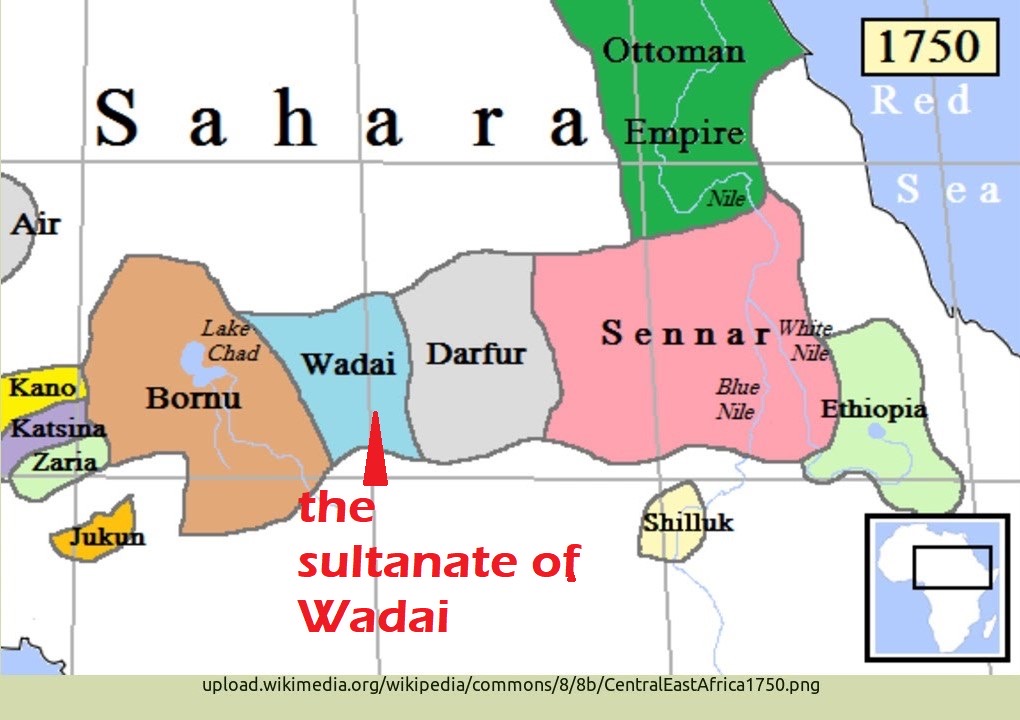
In 1487 when Duarte Pereira wrote of the coast of South West Nigeria as “Ijebu country”, the Sultanate of Wadai was not even in existence yet.
This is why that fraudulent historical claim fills one with anger.
The Ijẹbù are not, as Awujale Síkírù Adetọ̀nà claims, from a place called Wadai. Certainly not.
The area known as Wadai is now partly in the Republic of Chad, in Sudan and in the Central African Republic. It is located east of Lake Chad, well outside the current borders of Nigeria. It is even further away from current Nigeria than the old Bornu Empire, which was driven by climate adversity to shift from the far north of Lake Chad, fully to its current position now in Borno State, Nigeria.
At any rate, the indigenous black African people of the area later called Wadai were called the Tunjur. To their east was the Sultanate of Darfur, in present day Sudan. They practiced traditional African religions.
Unfortunately for them, they tolerated Arab outlaws who started to congregate in their midst. Mistakenly for them, they were tricked to absorb Islam from the Arabs.
After a while, the Arabs claimed that the rulers who the Tunjur had known since the dawn of time, were not practicing perfect Islam.
In 1635, some minority, outlying Tunjur tribes, with an eye for the main chance, rallied to a jihad called by one of the Arabs who the rulers of the Tunjur people had accommodated.
The immigrant Arabs then overran them, took over their land and announced their ridiculous “Sultanate of Wadai”.
That is the tragic story of the Tunjur.
Please note the dates very carefully.
In 1485, Portuguese adventurer and diarist, Duarte Pacheco Pereira, had recorded the long existence of Ijẹbù Country on our coast. In 1635, one-hundred-and-fifty [ 150 ] years later , the Sultanate of Wadai was created.
Lagos State and any part of Ogun State are not disputed territories. They are emphatically, Yorubàland.
Yorùbas are not co-equal immigrants with anyone in the Yorùba Western Region or on the coast of the Yorùba Western Region !
We Ijẹ̀bu have been in our present location from the dawn of time. Ijẹbù legend traces Ijẹbù ancestry from a progenitor called Ọbántá. Reputedly, Ijẹ̀bus came from Ifẹ̀.
So, how did Sikirù Adetọnà come by his fairytale Wadai story ?
Read very carefully.
My father, Chief Timothy Adeọlá Odutola, it was, who used to regale us with details of a remarkable incident. He was the elected representative of Ijẹ̀bu Province in 1947. He was a delegate to the African Conference in London in 1948. At one of the lunch breaks, he saw a man who had three vertical marks on each cheek, just like he does. He approached the man, saying in Ijẹ̀bu, “How come you came here as a delegate from home and I don’t know you ?” Papa would say that the puzzled man then assured him that he was not from Ijẹ̀bu or from Nigeria at all, but from the Wadai part of Sudan.
Now, an almost daily visitor to my childhood home in the 1970s was Awùjalẹ Síkírù Adetọnà. He will sit on the patio with my father with the door left wide open as we watched television in the main living room. His jokes entertained my father and my father clearly thought he was good company. Awujalẹ Sikirù Adetọnà would laugh and guffaw. You could hear him across the lawns in the first section of our compound. His children also spent their holidays with us, so he was never in a hurry to return to his house. What with my father plying him with gifts of cash etc. It was on one of such nightly visits of the Awùjalẹ that I first saw, in my father’s bedroom, that money can come, packed like a brick, in cellophane, straight from the bank.
My father would have regaled HRM Oba Síkírù Adetọnà too, with that African Conference anecdote.
Now, astonishingly, I believe it is on this slender, really tenuous piece of anecdotal evidence that HRM Ọba Síkírù Adétọnà has built up his ridiculous theory that the Ijẹ̀bù people came from Wadai.
Incidentally, parts of Ífẹ̀ also adopt the same marks that Ijẹ̀bus use.
Of course the real issue was that when Chief Awólọ́wọ̀ from sleepy, little Ikẹnnẹ, sought to unseat him, HRM Síkírù Adétọnà floated the story that his own Ijẹ̀bù was different from Awólọ́wọ̀’s Ijẹ̀bu.
This was to create a division amongst the Ijẹ̀bu that would make it seem as if Chief Awólọ́wọ̀ disliked Síkírù Adétọnà because Síkírù Adétọnà was of a different Ijẹ̀bu race entirely. To thereby fraudulently reinforce physical support for himself, Síkírù Adetọnà, amongst the people of Ijẹ̀bu-Ode where he lives. Physical support because it was the eve of Síkírù Adetọnà’s near removal from the throne of Ijẹ̀bu-Ode. In January 1984 when the government of President Shehu Shagari was removed in a military coup, the governor of Ogun State, Chief Ọlabísí Ọnabanjọ had already concluded plans to dethrone Sikirù Adetọnà and have him banished away from Ijẹ̀bu-Ode.
Understandable.
Chief Awolọwọ found Sikirù Adetọna despicable and was determined to remove him from the Awujalẹ stool. There was a reason. Sikirù Adetọna started disrespecting Chief Awolọwọ as soon as he was made Awujalẹ. Yet, my father, the Regent, it was, who singlehandedly made Sikiru Adetọna the Awùjalẹ. Ignore anything in his book to the contrary. My father was able to make it his personal choice. Now, that was only because Chief Awolọwọ, then premier of the Western Region deferred to my father entirely on the issue. An ingrate, Sikiru Adetọna chose to constantly disrespect Chief Awolọwọ thereafter. That brought my father’s judgement into question, as the person who picked Sikiru Adetọna. Picked, just because he had attended Adeọlá Odutola College. My father chose him, regardless of the keen interest at that time, of Ijebu-Ode families of a much better pedigree.
Though quite upset, Chief Awolọwọ retained his cordial relationship with my father. They remained friends.
Point is, now that Chief Awólọ́wọ̀ has passed away, and no longer a threat to Awùjalẹ Sikiru Adetọnà, it’s time to bury the Wadai fiction too.
Ijẹ̀bu Province, once represented by my father, Chief Timothy Adeọlá Odutola, was made up of Ikorodu, Ìkẹ̀nnẹ́, Ijẹ̀bu-Ígbó, Ijẹ̀bu-Ode, Ìpẹ́ru, Ìsharà, Ódò-Ọwá, Shàgàmù, Ẹpẹ̀, the Ijẹ̀bu Peninsular etc.etc, all the way along the Atlantic Coast, to Lìgàlí Ayọrìndè Street on Victoria Island, Lagos. In all, there are 234 towns and villages in Ijẹbùland.
Parts of the Ijẹ̀bu Peninsular came to be called Lekki after the Scottish land surveyor who was mapping out Ijẹ̀bu lands to be taken over by the British, after the Anglo-Ijẹbù war. His name was Leaky.
The Ijẹ̀bu coast extends from east of Ábígí in Ijẹ̀bu Waterside to Lìgàlí Ayọrìndè Street, Victoria Island. As the crow flies, Ijẹ̀bu-Ode, capital of the Ijẹ̀bus, is just 21 kilometres from the Atlantic ocean. Ìkòsì-Kétú after Victoria Island is decidedly Ijẹ̀bu.
The Aworis are native of the areas west of Lagos Island and Apapa. They were hunters. Hunters and wanderers do not own the land. They lived under the suzerainty of the Yoruba kings in Ẹgbàdò, now in Ogun State.
So, if that one who calls himself Rilwan Akiolu insists, as he does, that 9-square-kilometre-Lagos Island is Bini and not Yorùba, then 99.99% of Lagos State is still inalienable Yorùbaland.
Coming back now to the story of Wadai and the Tunjur.
At any rate, a certain Arab trickster now insisted to the Tunjur that he was a nobleman of the Arab Abbasids who had their capitals in Bagdad and in Cairo. He assumed the name and style of Abd al-Karin Al Abassi. He then tricked the outlying minority Tunjur tribes to use a jihad to take over the land of the Tunjur.
He promptly established what he then called the Sultanate of Wadai. Its main settlement is Abéché, now in Chad.
So, it was about Arab expansionism afterall, not about the practice of perfect Islam !
Thus were the Tunjur subjugated in their own land.
The point is, the Ijẹ̀bu had been in Ijẹ̀buland, definitely thousands of years before the Sultanate of Wadai was created.
It is therefore simply so preposterous and hopelessly fraudulent for anyone to claim that the Ijẹ̀bu came from somewhere called Wadai.
The point is, anybody who insists that the Ijẹ̀bu are co-equal immigrants in Ijẹbùland with peoples from other parts of Nigeria puts we and our children at a disadvantage. In trying to dilute or erase the Ijẹ̀bu identity of Ijẹ̀buland, he puts us in jeopardy. Erasure is a form of genocide acknowledged by the United Nations. Erasure was how the Armenian Genocide started. Please go online and look up the – Armenian Genocide.
That person clearly puts us in danger. That person should be stripped of any authority to speak on our behalf.
Now, coming pointedly to the subject of Awùjalẹ Síkírù Adetọnà’s preposterous Wadai claims, Yorùba kings who claim that they are not Yorubà should please just get out of Yorùbaland, and leave us alone.
Fẹmi Odutọlá Esq.
MK9 2BE
@odutolaodutola1
femiodutola.rechtsanwalt@aol.com